
Practical guide
ChatGPT Ads How advertising in ChatGPT works.
A new advertising channel needs a sound business decision. This guide explains ChatGPT Ads and shows how to prepare and evaluate a controlled test while keeping paid advertising separate from organic AI visibility.

ChatGPT Ads
Advertising in ChatGPT
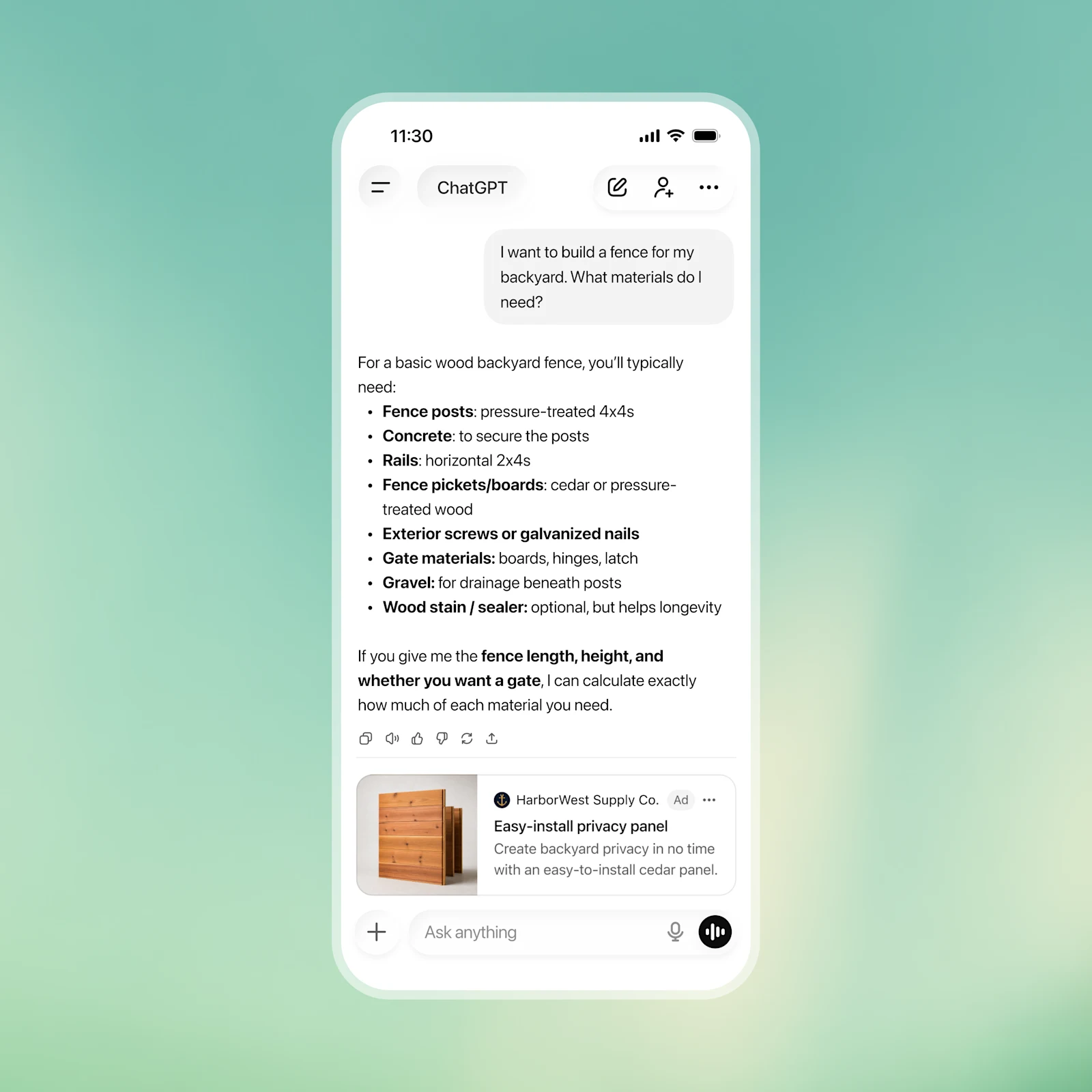
A question becomes a conversation.
A relevant ad can open the next door.
The short answer
ChatGPT Ads are paid, labelled advertisements in ChatGPT. They give businesses a way to present an offering in a conversational setting. A useful starting point combines an account check, a specific offer, a relevant landing page and a limited test budget with meaningful measurement.
What are ChatGPT Ads, and where do they appear?
Ads are displayed separately from responses. Eligible Free and Go users may see them; OpenAI says Plus, Pro, Business, Enterprise and Edu remain ad-free. Buying an ad does not buy influence over the answer.
For planning, focus on the customer’s task: what does your offer solve, which questions arise before a decision, and what information should the landing page provide? These questions form a test brief. They do not guarantee delivery in any particular conversation.
Sources: OpenAI Help Center: Ads in ChatGPT
Where are ChatGPT Ads available?
On 21 October 2026, OpenAI announced expansion to 89 countries. The Ads Manager availability list checked on 22 October includes Germany, Austria and Switzerland for self-service. The location of the legal entity being billed matters.
Country availability does not replace an account review. Check verification, billing, category eligibility and the markets your account can actually target. New self-service accounts may initially be restricted to their home country. Plan international campaigns around confirmed account access.
Sources: OpenAI: ChatGPT Ads expands to 26 new countries (21 October 2026) · OpenAI Help Center: Ads Manager Availability · OpenAI Help Center: Creating campaigns for ChatGPT Ads
Which advertising formats are available today?
For planning, distinguish standard ads, product-feed ads and new test formats. This overview reflects the documentation checked on 22 October 2026. An announced format is not automatically available to every advertising account.
Documented in Ads Manager
Standard ad
A labelled ad below a response, with a brand, headline, description, image and destination. Actual use requires account eligibility and ad approval.
Official documentationFeed campaigns · Beta
Product-feed ads
For retailers with a catalogue: ads use structured product details such as images, titles and prices. A feed does not buy organic shopping results. Account and feed eligibility need checking.
Official documentationUS test announced
Visual ads during image generation
An image-led format separate from the generated image. On 5 October, OpenAI announced a US test with selected advertisers for later in the month. General availability in Germany is not established.
Official documentationLimited alpha test
Sponsored Agents
People can open a conversation with a business’s AI representative from an ad. Access is restricted to selected advertisers; OpenAI is not currently accepting early-access requests.
Official documentation
Formats are different from campaign objectives and billing models. CPC and CPM describe how spend is charged; they are not separate visual ad formats. Check current availability in your account before planning.
Sources: OpenAI Help Center: Ads in ChatGPT — The Basics · OpenAI Help Center: Create Campaigns from Product Feeds · OpenAI: Building advertising for the way people use AI (5 October 2026) · OpenAI Help Center: Sponsored Agents in ChatGPT Ads
How does interest become a measurable inquiry?
Our planning model follows four stages: need, ad, landing page and business outcome. Each has a distinct job. The ad must be understandable, the page must deliver on its promise, and evaluation must assess quality as well as activity. The diagram is a strategic illustration created by DZMG.
From customer need to business outcome
A question. A relevant offer. A next step.
People come to ChatGPT with something specific in mind. That can be a useful moment to discover your offer. Follow two different customer journeys.
The question for ChatGPT
“What kind of privacy screen would suit my small terrace and be straightforward to install?”
A homeowner is planning a terrace
An idea becomes a specific question
The homeowner wants a more comfortable outdoor space. They ask about materials, space and installation. The conversation helps them understand which solution might fit their home.
Their interest: find a suitable product
Your ad introduces a possibility
A labelled ad for privacy panels may appear below a relevant response. Your business presents a specific product through an image, a useful benefit and a link to the right page.
Your opportunity: make a relevant offer visible
The click leads to a potential solution
The visitor explores your product page. Dimensions, materials, installation guidance and delivery details help them judge whether the product solves their problem.
The landing page: answer the next practical question
Interest can become a purchase
They might order the product or ask about the right size. DZMG connects creative, landing pages and measurement so you can assess which visits contribute to purchases or valuable inquiries.
Your evaluation: outcome quality as well as clicks
Fictional examples for illustration. An ad may appear in a relevant, eligible setting; a question does not automatically trigger delivery. The ChatGPT answer remains independent of the ad.
ChatGPT Ads, SEO and GEO serve different purposes
Paid campaigns and organic visibility require different budgets, content and evaluation methods. An ad booking does not book your business as a source in an AI answer. A technically sound, useful website can support both areas, but their results should be assessed separately.
Swipe horizontally to read the table.
| Area | Purpose | Useful evaluation |
|---|---|---|
| ChatGPT Ads | Paid advertising with a separate campaign budget | Advertising costs, qualified inquiries or purchases |
| SEO | Organic discovery in search engines | Relevant search visits and business outcomes |
| GEO / AI Visibility | Make content and entities understandable to AI search systems | Observed citations, mentions and relevant visits |
How do context and targeting work?
Context hints describe relevant needs at ad-group level. They are not exact-match keywords and do not guarantee delivery. Separate use cases that require different messages or landing pages.
Check available location and other targeting settings in the account. OpenAI describes restrictions on personalization and custom audiences in the EEA and Switzerland. Do not copy Google Ads or social audience structures without checking suitability. Advertisers do not receive private chat histories; reporting does not reveal individual conversations.
Sources: OpenAI Help Center: Ads in ChatGPT · OpenAI Help Center: Creating campaigns for ChatGPT Ads · OpenAI Help Center: Create Ad Groups for ChatGPT Ads
Which businesses should consider a test?
From our consulting perspective, a test is worth considering when customers ask questions, compare alternatives or seek help with a specific task before purchasing. A clearly explained offer and a useful landing page matter more than belonging to a fashionable category.
Potential assessment cases include a specialist retailer with clear product benefits, an education provider with defined learning outcomes, or a local service with an explicit service area. These are planning scenarios, not statements that every such offer will be approved or perform profitably.
A test is less useful when the offer lacks differentiation, the landing page leaves basic questions unanswered, or the team already struggles to handle existing inquiries. Weak measurement can also limit learning enough to justify fixing the foundations first.
- The offer solves a specific problem and can be explained clearly.
- Margin or qualified lead value supports a limited experiment.
- Your team can respond promptly and report on lead quality.
- The category, advertising and landing page pass a separate policy review.
What do you need before the first campaign?
Prepare a short brief covering the offer, market, language, audience, landing page and desired action. Add verified product information, approved images and a named content and budget approver. Establish account ownership and the access rights given to external providers.
Check the mobile journey from an ad click to completion: loading behaviour, understandable benefits, relevant evidence, a clear contact route and a working form or checkout. A reachable URL alone does not make a useful landing page.
For regulated or sensitive offers, check eligibility before producing assets. OpenAI’s advertising policies distinguish prohibited and restricted categories. Assess the specific offer rather than assuming a blanket industry approval.
Sources: OpenAI: Ad policies (10 September 2026) · OpenAI Help Center: Creating ads for ChatGPT Ads
How do you set up ChatGPT Ads step by step?
The official structure consists of campaigns, ad groups and ads. A campaign holds the objective and budget; ad groups organize needs; ads connect messages to landing pages. Account verification and billing are also prepared in Ads Manager.
We recommend starting with a small number of clearly differentiated hypotheses. A long list of nearly identical ads makes interpretation harder. Before setup, document the difference being tested and the result that would justify a change.
- Check access, account ownership, billing and permissions.
- Choose a primary business outcome and an available campaign option that fits it.
- Review the budget limit, timing and eligible target markets.
- Create separate ad groups for distinct needs and write precise context hints.
- Prepare differentiated ads and relevant landing pages.
- Check links, measurement and approvals before publishing in the ad account.
- After approval, inspect actual delivery and evaluate business outcomes.
Sources: OpenAI Help Center: Quickstart — Launch your first campaign
How much do ChatGPT Ads cost?
Official documentation describes CPC and CPM buying, among other options. That does not establish a universal click price. Check the objective, billing model, account settings and available capabilities together. A conversion-optimized campaign does not automatically mean paying per conversion.
Separate three costs: platform media spend, setup including creative and landing-page work, and ongoing management and reporting. When reviewing a proposal, ask which deliverables are included and which costs are charged directly through your ad account.
Size a test around the economic question. What can an additional customer cost under your assumptions? How uncertain are close rates and margin? Use those answers to define a sensible limit. A platform minimum is not a recommendation for a test budget capable of producing useful evidence.
Sources: OpenAI Help Center: Creating campaigns for ChatGPT Ads · OpenAI: New ways to buy ChatGPT ads (5 May 2026)
How do you measure results without false confidence?
Decide before launch whether the meaningful outcome is a purchase, a qualified inquiry, a booked appointment or another business event. A submitted form and a suitable new customer are different results. Build that distinction into the measurement plan.
OpenAI describes pixel and Conversions API measurement. Check separately which integration is available in the account and suitable for the website. Before collecting additional data, establish the data scope, consent process and technical ownership. This guide does not install tracking.
Use consistent campaign identifiers and check the path through analytics and your CRM. Compare platform reports with actual handled inquiries or orders. Attribution rules, reporting periods and missing consent can explain differences; making totals identical is not the objective.
A strong click-through rate indicates a response, not profitability. Small samples can fluctuate substantially. Document gaps and avoid presenting early findings as more precise than the evidence allows. A controlled comparison may help investigate incremental impact where data volume and the business model support it.
Sources: OpenAI: New ways to buy ChatGPT ads (5 May 2026) · OpenAI Help Center: Creating ads for ChatGPT Ads
A practical test case: professional training
This example is fictional and is not a DZMG client result. A provider wants to promote a specific training course. Its team can explain the curriculum, answer questions and distinguish suitable inquiries from poor-fit contacts.
Common questions before getting started
Do you need an agency? Not necessarily. An experienced internal team can prepare its own test. External support can help when strategy, creative, landing pages and measurement need to be addressed together, or when internal capacity is limited.
Does ChatGPT Ads replace Google Ads? There is no universal answer. Assess the additional channel against the same business criteria while accounting for differences in usage context. Any budget shift should follow your own results.
How quickly will results arrive? The channel name cannot establish a reliable timeline. Access, approvals, delivery, demand and the sales cycle all influence progress. Agree on review points rather than a blanket success date.
What makes a useful first test? It supports a defensible decision: which hypothesis was tested, what evidence is available, and what follows from it? A well-founded decision to pause can also be a useful outcome.
Sources and scope
Sources checked on 22 October 2026. The linked primary sources support the product-specific statements. Examples, diagnostic tables and priorities are our own practical guidance. Individual systems and account configurations need to be checked separately.
- OpenAI: ChatGPT Ads expands to 26 new countries (21 October 2026)
- OpenAI Help Center: Ads Manager Availability
- OpenAI Help Center: Ads in ChatGPT
- OpenAI Help Center: Creating campaigns for ChatGPT Ads
- OpenAI Help Center: Create Ad Groups for ChatGPT Ads
- OpenAI: New ways to buy ChatGPT ads (5 May 2026)
- OpenAI: Ad policies (10 September 2026)
- OpenAI Help Center: Quickstart — Launch your first campaign
- OpenAI Help Center: Creating ads for ChatGPT Ads
- OpenAI Help Center: Ads in ChatGPT — The Basics
- OpenAI Help Center: Create Campaigns from Product Feeds
- OpenAI: Building advertising for the way people use AI (5 October 2026)
- OpenAI Help Center: Sponsored Agents in ChatGPT Ads
Start ChatGPT Ads with a clear brief
DZMG supports suitability reviews, campaign strategy, creative, landing pages and evaluation. Explore the service page for scope and potential deliverables.